
Aaron’s Night Runner
Cat PersonThis thread traces Aaron’s struggle to teach amid ridicule, his encounter with a local account of night runners, and the chase that reframes his fear and authority.
increasing Bearing strength in each event
 decreasing
Bearing strength in each eventdecreasingA Hostile Classroom

A Hostile Classroom
The assignment
Aaron, a volunteer from Texas, is assigned to the first-year girls at Butula Girls’ School. Other teachers warn him that the class is notoriously difficult, and his reluctance to use physical punishment leaves him struggling to maintain order.
The girls mimic his speech, throw objects, and challenge his authority. Their conduct unsettles him, but the classroom also exposes how little he understands about the social world he has entered.
A fragile connection
Aaron singles out Linnet for praise, treating her as a pet pupil. The attention does not protect him: Linnet follows him home with other girls, who mock him by meowing.
The incident sharpens the mismatch between his good intentions and his assumptions. He has come to help, yet the girls see an outsider whose authority and kindness do not automatically earn trust.
The First Night Knocking
The First Night Knocking
An unexplained visitor
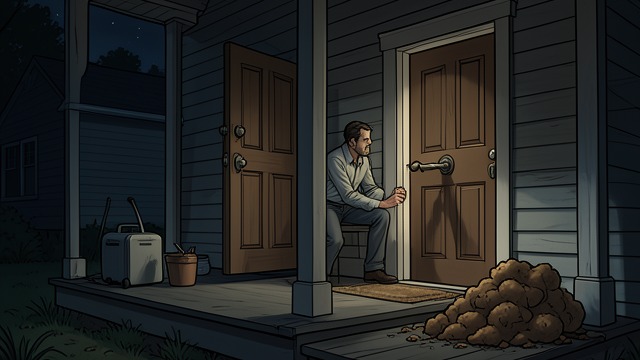
Aaron wakes to relentless knocking at his door. Each time he opens it, the courtyard is empty; when he tries to catch the visitor by moving outside, the noise stops and then begins again.
The repeated failure to find anyone turns irritation into fear. Alone in the dark, Aaron imagines emergencies and threats, while the sounds seem to surround the small house and deny him rest.
A humiliating discovery
At dawn the knocking ends, but Aaron finds a steaming pile of excrement on his veranda. He cleans it himself, ashamed and angry, then stays away from school, unable to identify which student might be responsible.
The attack is both a practical violation and a blow to his sense of control. The same students who disrupt his classroom appear capable of reaching him at home, where his authority offers no protection.
Grace Names the Threat

Grace Names the Threat
A local explanation
Aaron tells Grace about the knocking but withholds the excrement, expecting her to laugh at him. Instead, she names the attacker a night runner, describing a person who runs naked at night and may leave a filthy gift.
Her account places his experience within local knowledge that the Peace Corps training never gave him. Aaron is skeptical, but Grace’s conviction unsettles him more than a joke would have.
Humor and solidarity
Grace explains that night runners are human beings driven by a demonic mental disturbance, and jokes about their ability to transform into animals. Aaron objects that she is not being sympathetic; she replies that hardship does not make laughter impossible.
Their exchange exposes a gap between them, but also a form of companionship. Grace refuses to treat Aaron as either a helpless victim or an expert observer of his own situation.
The Cane He Cannot Use

The Cane He Cannot Use
Advice from the headmaster
Aaron brings his complaints to the headmaster, listing the class’s insults and the nighttime harassment. The headmaster treats the night runner as a community problem and recommends that Aaron discipline the girls physically.
The advice turns a cultural explanation into a justification for violence. Aaron is placed between his fear of being powerless and his conviction that beating the students would be wrong.
Mercy’s quiet defiance
When the girls greet him with a collective meow, Aaron grabs Mercy and prepares to cane her in public. She whispers “meow” as he raises the switch, and he cannot strike her.
He leaves the schoolyard without resolving the classroom conflict. His refusal is not a triumphant victory; it is an admission that the authority offered to him would make him complicit in the cruelty he came to oppose.
The Chase Becomes a Run
The Chase Becomes a Run
A last confrontation
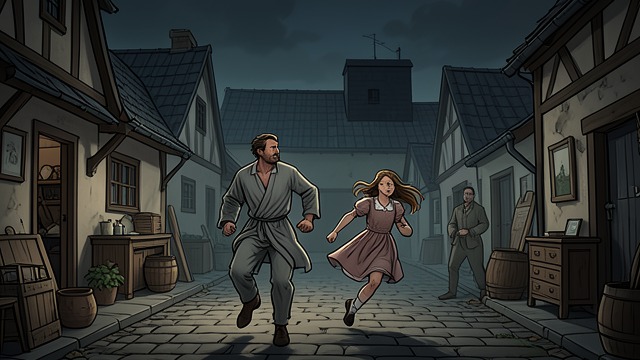
After Aaron decides to leave the village, knocking again circles his house. He waits with a long blade, feeling humiliated and determined not to remain passive, then opens the door and nearly strikes a pair of dangling legs.
The figure escapes onto the roof and then into the night. Aaron pursues it, abandoning caution as anger takes over, and runs through the village and into the surrounding darkness.
A changed perspective
The chase brings Aaron to a school celebration, where the girls see him as a disheveled stranger and call him the night runner. Their fear lets him understand how he might have appeared to them all along: pale, out of place, and frightening.
Grace then appears, invites him to run with her, and races naked into the darkness. Aaron follows. The ending does not undo his decision to leave, but it replaces his isolation with a fleeting, shared act of movement and trust.
Early in Aaron’s Peace Corps placement at Butula
The night after the girls follow Aaron home
The evening after Aaron’s sleepless night
The morning after Grace explains night runners
Aaron’s final night in Butula
